Dumb Beasts
The Magician's NephewDumb Beasts are the animals Aslan does not awaken into speech when Narnia begins. They are not outside the new world’s community: Aslan gives them to the Talking Beasts to care for, making the distinction between speaking and non-speaking animals both a boundary of identity and a responsibility of stewardship.
Place in Aslan’s Charge
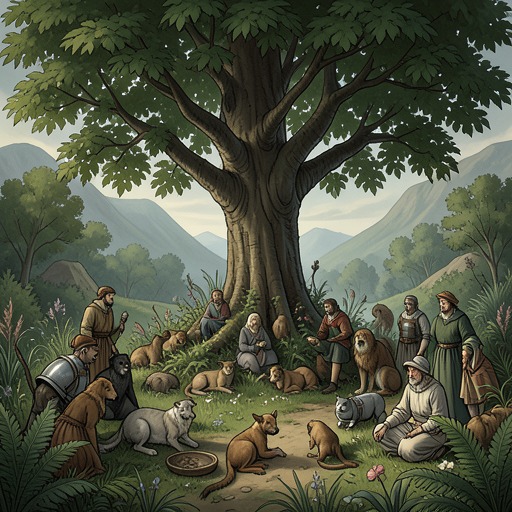
In his address to the newly awakened creatures, Aslan gives them Narnia’s woods, fruits, and rivers, along with the stars and himself. He also gives them the Dumb Beasts, whom he has not chosen to make Talking Beasts, and commands them to treat those animals gently and cherish them. The instruction makes care for non-speaking creatures part of the first moral order of Narnia, rather than a matter left outside it.
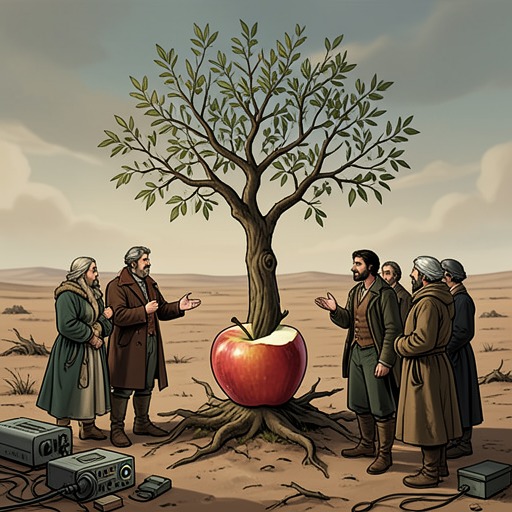
Aslan connects the two kinds of creature through their shared origin: the Talking Beasts were taken out of the Dumb Beasts, he says, and can return to them. The warning not to go back to their former ways therefore makes speech a vulnerable distinction, not an irrevocable privilege. The new animals’ promise not to revert is followed by Aslan’s assurance that speech need not make them solemn: they may laugh as well as pursue justice.
The Boundary of Speech
The difference between speaking and non-speaking animals becomes concrete in the encounter with Uncle Andrew. When a Bulldog addresses him, Andrew hears what he thinks is a snarl and growl and responds with a soothing phrase, but the beasts hear no words from him—only a vague sizzling noise. Their failure to understand one another shows that speech in Narnia is more than the production of sound: it marks participation in a shared language that Andrew cannot enter.
The episode also reverses the usual human assumption that an animal’s apparent silence makes it an object of human interpretation. The beasts cannot make sense of Andrew’s speech, while he mistakes their words for threatening noises. Their bewilderment ends when Andrew faints; a Warthog concludes that he is only a tree, since the animals have never seen anyone faint or fall. The scene presents Narnian animal understanding as its own developing perspective, not simply as a human judgment translated into animal voices.
Work, Memory, and Care
Before the awakening, Strawberry is a horse used for work and care by the Cabby. When the group returns to the wood, the thirsty horse heads toward a pool, but Polly’s warning about the green rings interrupts his drink and sends the whole party into darkness. Later, as a Talking Beast, Strawberry recalls fragments of his former life: he remembers a black object tied behind him and being struck to make him run, as well as the Cabby bringing him warm mash, rubbing him down, and putting a cloth over him in the cold.
Strawberry’s recollection does not reduce his past to either kindness or exploitation. He remembers the Cabby’s practical care, but also the harnessed work that made him run. His account gives the transition from Dumb Beast to Talking Beast a personal dimension: awakening brings not only speech but an emerging ability to interpret prior experience and recognize relationships. The Cabby’s claim of familiarity meets Strawberry’s initially uncertain memory, which gradually begins to return.
Animal Agency and the Story’s Contrast
The story places animals in sharply different human roles. Uncle Andrew’s account of his experiments describes guinea pigs as test subjects: some died, while others exploded, and he defends the experiments on the ground that he had bought them for that purpose. Against this instrumental treatment, Aslan’s command to cherish the Dumb Beasts establishes a different standard, while Strawberry’s memories make care and labor visible from the animal’s own emerging point of view.
The Dumb Beasts consequently matter even when they do not speak. Their presence defines the limit of Aslan’s awakening, gives the Talking Beasts an obligation toward creatures less empowered than themselves, and supplies the origin to which speech might be lost. The distinction is not simply between valuable and valueless life: Aslan’s charge makes the non-speaking animals’ protection a test of what the newly speaking community will do with its power.